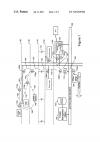
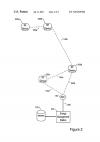
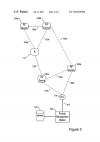
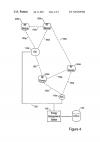
Systems and methods for ensuring data integrity in a mesh network. A mesh network can include multiple RF devices. Transmitting quality data in or on the mesh network is improved using communication validation functions. The communication validation functions ensure a reliable communication network, preserve data during a network outage, and validate data. The communication validation functions can measure or control data quality within a communication and analysis network. The communication validation function operates to control data quality, for example, by measuring the quality of wireless links, ensuring the presence of redundant links, testing the ability of the mesh network to establish a backup communication path, generating alarms based on communication thresholds, tracking the communication path followed by communication packets, and identifying placement locations for additional RF devices.
CROSS-REFERENCE TO RELATED APPLICATIONS
This application is a continuation-in-part of U.S. application Ser. No. 11/083,909, filed Mar. 18, 2005 and entitled “Solar Powered Radio Frequency Device Within an Energy Sensor System”, which claims the benefit of U.S. Provisional Application No. 60/554,188, filed Mar. 18, 2004 and entitled “A Non-Intrusive Energy Sensor with Wireless Communications”. This application is also a continuation-in-part of U.S. patent application Ser. No. 10/892,837, now U.S. Pat. No. 7,089,089 entitled “Methods and Apparatus for Retrieving Energy Readings from an Energy Monitoring Device” and filed Jul. 16, 2004, which claims the benefit of U.S. Provisional Application No. 60/488,700 filed Jul. 18, 2003 and entitled “A Wireless Communication Network and RF Devices for Non-Intrusive Energy Monitoring and Control.” This application is also related to U.S. patent application Ser. No. 11/122,411 entitled “Grouping Mesh Clusters” and filed the same day as the present application. The foregoing applications are incorporated by reference in their entirety.
In building automation architectures, components may be associated through physical communications paths and at a different level through building automation applications. Building automation applications implement control processes for a building function. Due to changing needs, such as a failure of a physical communications path or the addition or removal of components, the building automation application may be more appropriately performed in a different device. By dynamically positioning or determining a processor for implementing a building automation application, an architecture or network may more optimally control building functions, such as by requiring less user input, more rapid response and/or avoiding building function failures.
An energy measurement system including a radio frequency (“RF”) device powered by a solar panel. The RF device comprising a wireless communication port operative to transmit and receive communication over a wireless network of additional RF devices. The energy measurement system able to transmit energy parameters of the RF device over the wireless network.
A method and system for spatial data manipulation input and distribution via an adaptive wireless transceiver. The method and system include a wireless transceiver for automatically and adaptively controlling wireless transmissions using a Waveform-DNA method. The wireless transceiver can operate simultaneously over both the short and long distances. The wireless transceiver is automatically adaptive and wireless devices can send and receive wireless digital and analog data from various sources rapidly in real-time via available networks and network services.
A method and system for managing mesh network devices. A mesh network device with integrated features creates an N-way mesh network with a full mesh network topology or a partial mesh network topology.